Showing posts with label Avondale. Show all posts

Monday, July 29, 2013

A Klutho House For Sale

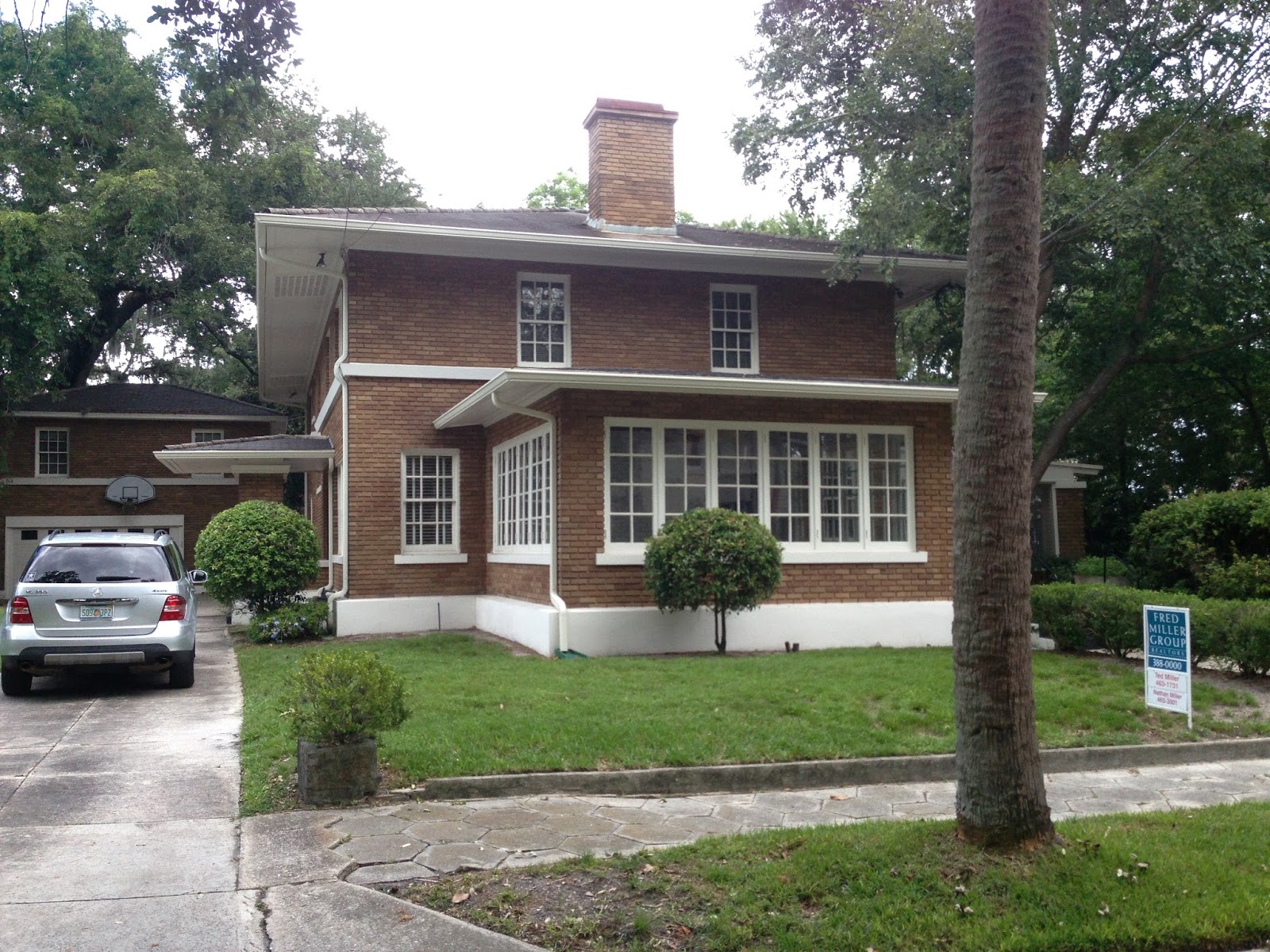
We recently had the opportunity to tour the Stockton Broome Residence, a beautiful home in historic Avondale, designed by architect H.J. Klutho, who produced some of Jacksonville's landmark architecture of the early 20th century.


1845 Elizabeth Place, Jacksonville, Florida, H.J. Klutho architect, 1914.  Klutho is the architect who brought the Prairie style to Jacksonville, yet this is one of only five residences of that style that he designed.  Most of his Prairie style landmarks are large commercial buildings, most notably his masterpiece, the St. James building downtown (the former Cohen Brothers department store, now Jacksonville City Hall).  This large home on exclusive Elizabeth Place was built for real estate promoter Stockton Broome.  He developed the street and named it after his daughter.


The main entrance to the house is on the side, a feature shared by many of the houses on Elizabeth Place.


The house is deep and the rooms are of grand proportions.  The living room has original light fixtures.  As Klutho typically designed every aspect of his homes it is safe to assume these fixtures are part of his original vision.


The dining room is truly banquet size and also features the original lighting and  many built-ins.


The hardwood floors in the house are beautiful and make me wonder about the rest of the woodwork.  I suspect it was not always hidden under a layer of paint!


Pause on the landing as you make your way up the stairs and appreciate the huge arched window.


Then continue up to the second floor and the bedrooms.


Here's the master bedroom.  It is enormous and has its own fireplace.


There are original pocket doors. 


And, in addition to four bedrooms (or maybe more...I lost count), there is a large library on the second floor.


Back to the first floor now, and you'll find something that is unusual in Florida.  A basement!  It is the real thing...and believe it or not, dry.


Here's a reminder of why this is such a lovely street.  Elizabeth Place, lined on both sides by significant homes like this one, ends at the St. Johns River.  The Stockton Broome residence is one house away from the river.


1845 Elizabeth Place is for sale for $725,000.  An original Klutho and a historic landmark!  What a deal!

Wednesday, October 12, 2011

Klutho's Kahler Apartments

This Avondale apartment building comes from later in the career of Henry John Klutho, one of Florida's greatest architects, and is one of two known buildings he designed in the Art Deco style.  Klutho's presence is pervasive in Jacksonville, from Avondale and Riverside to Springfield and downtown.  This is not typical of his work, which more often reflected the Prairie school.  Nevertheless, it is a special building.


Kahler Apartments, 3225 St. Johns Avenue, Jacksonville, constructed 1936.  The Kahler Apartments anchor the corner of St. Johns Avenue and Seminole Street, and show how Klutho's work evolved and changed over the years.  The Art Deco style is unusual in Avondale, yet the building does not seem out of place.  It blends nicely into the neighborhood's eclectic mix.


Two sets of tile-accented steps curve up to the front entrance from the sidewalk.  Art Deco lanterns flank the door, which is shaded by a projecting canopy, and direct the eye up the facade to a tower that rises above the roof-line.  The original metal casement windows were replaced in 1984 when the building was converted into condominiums.  It is a testament to Klutho's design that the Kahler holds up today, even with the modern windows.

 
The tiles on the steps add a splash of bright color to the building entrance.  There is more eye-catching tile-work on the back of the planter that separates the stairways.


The detail above shows the glass-block window above the canopy over the door.  Glass-blocks are common in Art-Deco buildings.  Here are closer views of the Art Deco-style lanterns and front door:


The Kahler Apartments face both St. Johns Avenue and Seminole Road.  As you can see, the Seminole Road entrance is identical to the St. Johns, however the Seminole Road side of the building is longer.


The plaque on The Kahler is evidence of the residents' respect for the renowned architect responsible for this important building.  Klutho came to Jacksonville after the great fire of 1901, helped rebuild the city, and, in the process, designed many landmark buildings, including the mammoth St.James building downtown, which was built as the home of Cohen Brother's Department Store, but is today Jacksonville City Hall. 


Although some of Klutho's most important works, such as the Seminole Hotel downtown, have been destroyed, dozens of his other buildings remain to impress and delight us.  The Kahler on St. Johns Avenue in Avondale, with its clean lines, impressive entry, and Deco details, is one of them.

Tuesday, October 11, 2011

Back to Jax: Avondale Terrace

I return to Jacksonville for a look at another of those beautiful Avondale buildings that is an "apartment island" in a sea of single-family homes...and pretty swank homes at that!  Actually, these apartments, in an equally grand building, are now condominiums, and the building is known as Avondale Terrace.


1786 Challen Avenue, Jacksonville, built in 1926.  Thank goodness for the Spanish/Mediterranean Revival craze of the 1920's that left so many memorable buildings in this neighborhood and across the state of Florida.  The most notable feature of this house is the profusion of arches from top to bottom. 

The front steps lead up through three broad archways to a tiled porch and three arched doors in this appealingly symmetrical building.  I have not been able to find any information about the architect or the layout of apartments.  I welcome input from anyone at Avondale Terrace who can provide this information!


This view of one of the front doors also gives a closer look at the spiraled columns which set off the building's entrance and the six front porches.  The only other ornamentation is a large decoration in the uppermost center of the facade.  Windows are standard double-hung.


Here is a closer view of one of the porches, which provides outside living space, and helps keep the apartment cooler in the summertime.


Again, note the spiraled columns, which can be seen on three sides of the porches.  The projecting beams are interesting too.  An ad for a condominium for sale in the building notes that you will overlook million dollar homes.  There's no doubt that was true before the real estate crash; I'll leave it to the experts to decide whether it's true today!  In either case, we can all agree it's a million dollar view.  This is a beautiful neighborhood.


Here's another view of 1786 Challen Avenue.  Garage parking for residents is behind the building, but you may choose to leave your car there and take a walk instead of driving.  The Avondale shopping district, the river, and many parks are minutes away in this pedestrian-friendly neighborhood.

Wednesday, October 5, 2011

Haddon Hall Apartments

Haddon Hall is a Tudor-revival style apartment building in the Avondale neighborhood by another famous and prolific Jacksonville team, Marsh & Saxelbye.  Avondale adjoins Riverside; the transition between the two riverfront neighborhoods is fairly seamless, largely because of their shared experience in the 1920's building boom.


Haddon Hall, 3311-3319 Pine Street, Jacksonville, constructed in 1927.  If you were strolling along Pine Street for the first time, Haddon Hall might take you by surprise.  This area between St. Johns Avenue and the river is populated almost exclusively with stately single-family homes, not apartment buildings.  This is in the heart of Avondale, described in a 1923 sales brochure as "the most beautiful residential development ever attempted in Jacksonville."  As it turned out, this was not hyperbole.  Avondale has some of the most beautiful residential blocks in the country.  Haddon Hall is very much at home here among its impressive single-family neighbors.

William Mulford Marsh and Harold Saxelbye began their partnership in 1919.  Marsh grew up in Jacksonville. Saxelbye was born in Hull, England, and practiced in New York for nine years before coming to Jacksonville to design the Mason (later Mayflower) Hotel downtown.  Their partnership lasted twenty-seven years until Marsh's death.  Marsh & Saxelbye dominated Jacksonville architecture during the 1920's building boom.

This is one of two Pine Street entrances to Haddon Hall, which contains eight apartments.  The building shares the name of a famous Tudor mansion in Derbyshire, England, near Saxelbye's birthplace of Hull.  Haddon Hall is rich with traditional Tudor features, including half-timbering, bay windows, gables, and ornate chimneys.  Here is a closer view of the arch over the entry, with the title Haddon Hall:


Brick, stucco, hewn stone, cast stone, and wood all figure in the surface treatments in the building.  The views below show details of the decoration around the arched entry and the lights that flank it.


And here's a look beyond the archway to the building's entrance with its vintage screen doors and double front doors behind them:

These details add to the character and appeal of Haddon Hall, an elegant living place that we would describe as a luxury apartment building today, but in the 1920's would more likely have been referred to as "high class".  As I took these pictures I lingered on the sidewalk, hoping a resident would come along and invite me in for a look at one of the apartments!  No such luck this time, but I'll try again.  Here's a detail of an upstairs sunroom.  Don't you want to go up for a visit?


It's easy to see why the name Marsh & Saxelbye is still a selling point for homes in Jacksonville.  Saxelbye, who handled most of the creative design work while Marsh oversaw building and construction, was considered Jacksonville's most artistic architect of the time.  Here are two more views of this fine building: 


Marsh & Saxelbye were responsible for hundreds of beautiful homes and commercial buildings in Jacksonville.  They are another pair of the talented people who contributed so much to the architectural heritage of the city.  The Florida building boom went bust by 1928.  Considering the short period of time prior to that in which neighborhoods like Avondale were conceived and built, the quality of the end result is remarkable.  What a pleasure that is for us today!